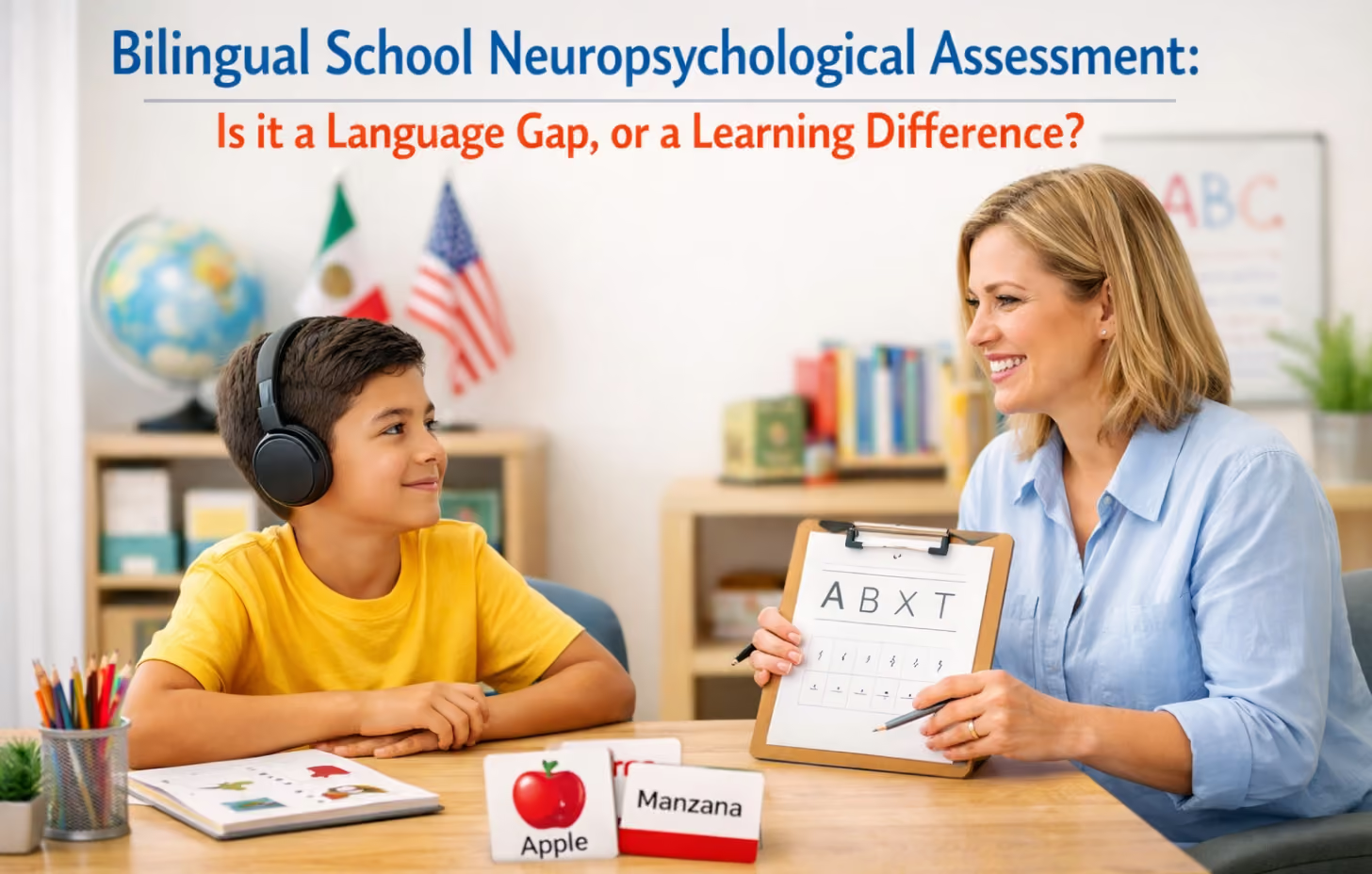
Bilingual School Neuropsychological Assessment: Is it a Language Gap, or a Learning Difference?

The Power of the Bilingual Psychological Assessment
You can’t just give a standard IQ test in English to a bilingual child and call it a day. That’s like asking a fish to climb a tree and then wondering why it’s not very good at it. A truly comprehensive bilingual psychological assessment involves several layers:
Native Language Testing
We must assess the child in their primary language. This gives us a baseline of their cognitive potential. If a child shows brilliant problem-solving skills in their native tongue but "low" scores in English, we know the "low" score is a reflection of language, not intelligence.
Dynamic Assessment
This is my favorite part. Instead of a "static" test where the child either knows the answer or doesn't, we use a "test-teach-retest" model. We give them a task, see how they do, provide a little bit of high-quality instruction, and then see if they can apply that new knowledge. A child with a language gap will usually "soak up" the instruction and show quick improvement. A child with a learning difference will often continue to struggle despite the teaching.
Culturally Responsive Context
We don't live in a vacuum. We look at the child’s whole story. When did they start learning English? What is the language used at home? What has their schooling looked like? At PEC Group, we pride ourselves on our Bilingual & Culturally Responsive Services. We aren't just checking boxes; we are connecting the dots of a child’s life to see the full picture.

Connecting the Dots at PEC Group
If you’re a parent in San Diego and you’re feeling overwhelmed by school meetings and "wait and see" approaches, we hear you. Navigating the world of IEPs and 504 Plans is hard enough without the added layer of bilingualism.
Our approach is neuro-affirming, which is just a fancy way of saying we don’t look at your child as a "problem to be fixed." We look at how their brain is wired and help you build a roadmap for their success. Whether it's a neurobehavioral evaluation or an Independent Educational Evaluation (IEE), we ensure that the child's linguistic background is treated as a context, not a barrier.
The Bottom Line
Differentiating a second-language learning process from a reading disorder is an art and a science. It requires a clinician who understands that "different" is not "deficient."
If your child is a bilingual rockstar who seems to be hitting a wall in school, don't stay in the "I wonder if…" phase. A thorough child neuropsychological assessment can provide the clarity you need to move from confusion to confidence.
Ready to get some answers? We’d love to help you navigate this journey. You can check out our FAQ for more info on how we work, or contact us directly to chat about your child’s unique needs. Let’s make sure their "superpower" stays a superpower!
And hey, if you want to stay in the loop on all things neuro-affirming and educational, join our newsletter. We promise it’s way more interesting than a school district memo!